What Is Shifa in Islam? The Meaning of Healing in the Quran, and the Duas for It

0
what is shifa in islam

This post contains Amazon affiliate links. If you buy through them, Hijab Forum earns a small commission at no extra cost to you.

Shifa is the Arabic word for healing, cure, or recovery. In Islam it carries more than the medical meaning. Allah is Ash-Shafi, the Healer, and the Quran calls itself a shifa. When a Muslim makes dua for someone who is ill, shifa is the word they use. Here is where the word comes from, where it appears in the Quran, and the duas for it from the Sunnah.

Shifa in the Quran

The word appears in several places, and each one says something about what healing is.

“And We send down of the Quran that which is healing and mercy for the believers” (17:82). The Quran as shifa for what is in the chest: doubt, hardness, grief.

“O mankind, there has come to you instruction from your Lord and healing for what is in the breasts” (10:57). Again, the healing of the heart before the body.

“And when I am ill, it is He who cures me” (26:80). The words of Ibrahim (peace be upon him), listing what Allah does for him. Every cure, whatever the means, is from Allah.

“There emerges from their bellies a drink, varying in colours, in which there is healing for people” (16:69). Honey, named as shifa for the body.

So shifa in the Quran is three things: healing of the heart through the Quran, healing of the body through what Allah has placed in creation, and the fact that all of it is from Allah alone.

Surah Al-Fatihah, the surah of healing

Al-Fatihah is called Ash-Shifa and Ar-Ruqyah. A companion once recited it over a man who had been stung, and the man recovered, and when they told the Prophet ๏ทบ he asked, “How did you know it was a ruqyah?” and approved (Bukhari). It is the surah to recite over a sick child, over yourself, and over anyone who asks.

The duas for shifa

When visiting someone who is ill. The Prophet ๏ทบ would say:

La ba’sa, tahurun in sha Allah. Never mind, may it be a purification, if Allah wills. (Bukhari)

And he taught that whoever visits a sick person whose time has not come and says the following seven times, Allah will cure them:

As’alullahal-‘azim, rabbal-‘arshil-‘azim, an yashfiyak. I ask Allah the Supreme, Lord of the magnificent throne, to cure you. (Abu Dawud, Tirmidhi)

For yourself, when something hurts. Place your hand on the place of pain and say Bismillah three times, then seven times:

A’udhu billahi wa qudratihi min sharri ma ajidu wa uhadhir. I take refuge in Allah and His power from the evil of what I feel and fear. (Muslim)

The dua the Prophet ๏ทบ made over the sick. In Bukhari and Muslim, he would wipe the sick person with his right hand and say:

Allahumma rabban-nas, adh-hibil-ba’s, ishfi antash-shafi, la shifa’a illa shifa’uk, shifa’an la yughadiru saqama. O Allah, Lord of mankind, remove the harm and heal, for You are the Healer. There is no healing except Your healing, a healing that leaves no illness behind.

This last one is the dua most people mean when they say “dua for shifa.” Learn it. It is the one to say over a child with a fever at 3 a.m.

Shifa and medicine

The Prophet ๏ทบ said, “Allah has not sent down a disease except that He has sent down a cure for it” (Bukhari), and “Seek treatment, servants of Allah” (Abu Dawud, Tirmidhi). Dua for shifa and going to the doctor are the same act of trust. One asks Allah directly, the other uses what Allah has made. A Muslim who makes dua and takes the medication is doing what the Prophet ๏ทบ did, since he used honey, hijama, and black seed and told others to.

Anyone who tells you that faith means skipping treatment has it backwards.

The Sunnah foods for shifa

Three come up in the hadith by name. Honey, which the Quran itself calls shifa. Black seed, which the Prophet ๏ทบ said is a cure for every disease except death (Bukhari). And zamzam water, which he said is for whatever it is drunk for. None of them replace a doctor. All of them are Sunnah.

Keeping the duas close

The three duas above, with Arabic, transliteration and meaning, are in Fortress of the Muslim under visiting the sick and pain in the body. For children, “When I get hurt” and “Visiting someone sick” are cards 24 and 25 in our 30 Everyday Duas for Kids set, so the words are on the wall before they are needed.

For the Sunnah of cupping, which the same hadith on honey mentions, see what hijama is in Islam.

Eid Gift Ideas for Him: 12 Gifts for Husbands, Fathers, Brothers and Sons

0
eid gift ideas for him

This post contains Amazon affiliate links. If you buy through them, Hijab Forum earns a small commission at no extra cost to you.

Men are hard to buy for, and Eid makes it harder, because the gift should feel like Eid and not like a birthday. Here are twelve Eid gift ideas for him, sorted by who he is to you, and chosen so that each one gets used in the first week.

For a husband

1. Oud. The Eid gift. Lattafa Khamrah is the one everyone’s husband has been asking about, and Bade’e Al Oud is the safer choice if he has not worn oud before. Both are under $55 and last all day.

2. A new thobe for Eid prayer. A plain white thobe with a stand collar. Give it the night before so he wears it to the prayer.

3. A Turkish coffee set. The DEMMEX copper pot and cups set for a man who makes the coffee after iftar and will now make it after Eid breakfast.

For a father

4. A prayer rug that is actually comfortable. The thick padded sajadah for knees that have been praying for sixty years. This is the gift a father will not buy for himself and will use five times a day.

5. The seerah. The Life of the Prophet Muhammad ๏ทบ, a one-volume seerah for someone who wants to read it start to finish.

6. Wall art for his study. The metal First Kalima piece from iwa concept. It goes above the desk and stays there.

For a brother

7. A sandalwood tasbih. Ninety-nine beads in sandalwood, which smells like something and feels like something. For the brother who has a plastic one in his car.

8. 365 Wisdoms of the Prophet. One hadith a day, on family, health, work and character. For the brother who says he does not have time to read.

9. A good oud at the lower end. Lattafa Asad, which is around $40 and smells more expensive than that.

For a son

10. His own prayer rug. For a boy old enough to pray on his own, a rug and tasbih set in a gift box. It marks the Eid he started praying next to his father.

11. A copy of the Quran in English. The Clear Quran for a teenager who is ready to read it himself.

12. Eidi, in an envelope he keeps. Cash is the traditional Eid gift for children and there is nothing wrong with it. Put it in a proper envelope with a note. He will keep the envelope longer than the money.

What to skip

Gadgets, which belong to birthdays. Anything with a Ramadan theme, since Ramadan is over. Clothes that are not for Eid prayer, because the thobe is the one piece of clothing that is an Eid gift and the rest is just shopping.

A note on oud

If he has never worn oud, give him a sample first or pick the lighter one. Oud is strong, and a bottle of the wrong one sits on a shelf for a year. Khamrah is sweet and warm. Bade’e Al Oud is smoky and classic. Asad is somewhere between and the easiest to wear every day.

For the women on your list, we have a separate post coming. For the children, the 30 Everyday Duas for Kids cards printed and tied with a ribbon are an Eid gift that lasts past the sweets.

12 Easy Ramadan Crafts for Kids (Paper Plates, Glue, and Not Much Else)

0
ramadan kids crafts

This post contains Amazon affiliate links. If you buy through them, Hijab Forum earns a small commission at no extra cost to you.

Ramadan crafts for kids have one job: fill the slow hour before iftar with something that ends up on the wall. These twelve use paper plates, construction paper, glue, and the crayons you already have. A few need one supply from the list at the end.

Lanterns

1. Paper plate lantern. Fold a paper plate in half, cut slits from the fold toward the edge, unfold, and curl it into a cylinder. Staple, add a paper handle, and hang it. A three-year-old can do the colouring and a six-year-old can do the cutting.

2. Construction paper fanoos. Fold a sheet of coloured paper lengthwise, cut slits along the fold, open, roll, and tape. Add a strip for the handle. Make six in different colours and string them across a doorway.

3. Jar lantern. A clean jar, torn tissue paper, and watered-down glue. Paint the glue on, press the tissue, let it dry, and drop a battery tea light inside. This is the one that stays out all month. The star lantern kit is the step up if you have an older child who wants something that really lights.

Moons and stars

4. Handprint crescent. Paint a hand yellow, press it on dark blue paper in a curve, and add star stickers. Date it. Do one each week.

5. Moon phase chart. Eight paper circles, coloured to match the moon as it changes over the month. Go outside and check the real one before colouring each. This is a craft and a science lesson in one.

6. Crescent and star mobile. Cut crescents and stars from card, punch a hole, and hang them at different lengths from a paper plate ring. Hang it where the air moves.

7. Stencil painting. For the youngest, Ramadan stencils with lantern and moon shapes and a sponge dipped in paint. No drawing skill needed and the results look like something.

Mosques

8. Paper plate mosque. Half a paper plate is the dome. Two toilet roll tubes are the minarets. A rectangle of paper is the building. Glue, colour, and add a crescent on top.

9. Window mosque. Cut a mosque silhouette from black card, glue coloured tissue paper behind the window spaces, and tape it to a real window. When the sun comes through, it glows.

Counting down

10. Paper chain countdown. Thirty strips of paper, one for each day, looped into a chain. Tear one off every morning. Write a good deed on each strip before looping if you want the chain to teach something too.

11. Good deeds tree. A bare tree drawn on a large sheet of paper. Each good deed earns a paper leaf with the deed written on it. By Eid the tree is full.

For Eid

12. Eid cards. Folded card, a crescent and star on the front, and the child’s own writing inside. One for each grandparent, one for a neighbour, one for a teacher. The rainbow scratch paper set makes cards that look impressive with very little effort, which is what you want from a six-year-old on the last day of Ramadan.

The supply list

Paper plates, construction paper in at least blue, yellow and green, glue sticks, child scissors, battery tea lights, a hole punch, and a roll of string. For the youngest, chunky washable crayons are safer than markers. Everything else is optional.

Colouring pages

If you want something with no prep at all, our colouring pages are simple bold outlines of the same scenes: lanterns, mosques, the iftar table, the Quran stand. Print, hand over the crayons, and get fifteen quiet minutes.

For the duas to go alongside the crafts, the 30 Everyday Duas for Kids set has one for every day of the month.

The Islamic Call to Prayer: What the Adhan Says and What to Say Back

0
islamic call to prayer

This post contains Amazon affiliate links. If you buy through them, Hijab Forum earns a small commission at no extra cost to you.

Five times a day, in every city with a masjid, somebody stands up and calls the same fifteen lines that have been called since Madinah. The Islamic call to prayer is the adhan, and if you have heard it from a minaret, from a phone app, or from a father in the next room, you have heard the same words the companions heard. Here is what they say, where they came from, and what the Sunnah teaches us to say when we hear them.

The words of the adhan

Allahu Akbar (four times). Allah is the greatest.

Ash-hadu an la ilaha illallah (twice). I bear witness that none has the right to be worshipped except Allah.

Ash-hadu anna Muhammadan rasulullah (twice). I bear witness that Muhammad is the Messenger of Allah.

Hayya ‘alas-salah (twice). Come to prayer.

Hayya ‘alal-falah (twice). Come to success.

Allahu Akbar (twice). Allah is the greatest.

La ilaha illallah (once). None has the right to be worshipped except Allah.

For Fajr, the line “As-salatu khayrun minan-nawm,” prayer is better than sleep, is added after “come to success.” It is the line everyone who has heard the Fajr adhan from a hotel window remembers.

Where it came from

In the first year after the migration to Madinah, the Muslims needed a way to gather for prayer. Bells and horns were suggested and set aside. Then a companion, Abdullah ibn Zayd, saw the words of the adhan in a dream, and Umar ibn al-Khattab reported the same dream. The Prophet ๏ทบ confirmed it and asked Bilal, may Allah be pleased with him, to call it, because of his voice. Bilal, a freed slave from Abyssinia, became the first muadhdhin, and the adhan has been called in his cadence ever since.

What to say when you hear it

The Sunnah is to repeat each line quietly after the muadhdhin, with one exception. When he says “come to prayer” and “come to success,” you say instead:

La hawla wa la quwwata illa billah. There is no might nor power except with Allah.

After the muadhdhin says the shahadah, the Sunnah adds:

Wa ana ash-hadu an la ilaha illallahu wahdahu la sharika lah, wa anna Muhammadan ‘abduhu wa rasuluh. Raditu billahi rabban, wa bi Muhammadin rasulan, wa bil-islami dina. And I too bear witness that none has the right to be worshipped except Allah alone, without partner, and that Muhammad is His slave and Messenger. I am pleased with Allah as a Lord, Muhammad as a Messenger, and Islam as a religion.

The dua after the adhan

When the adhan finishes, send blessings on the Prophet ๏ทบ and then say the dua he taught, which is in Bukhari:

Arabic

ุงู„ู„ูŽู‘ู‡ูู…ูŽู‘ ุฑูŽุจูŽู‘ ู‡ูŽุฐูู‡ู ุงู„ุฏูŽู‘ุนู’ูˆูŽุฉู ุงู„ุชูŽู‘ุงู…ูŽู‘ุฉูุŒ ูˆูŽุงู„ุตูŽู‘ู„ูŽุงุฉู ุงู„ู’ู‚ูŽุงุฆูู…ูŽุฉูุŒ ุขุชู ู…ูุญูŽู…ูŽู‘ุฏู‹ุง ุงู„ู’ูˆูŽุณููŠู„ูŽุฉูŽ ูˆูŽุงู„ู’ููŽุถููŠู„ูŽุฉูŽุŒ ูˆูŽุงุจู’ุนูŽุซู’ู‡ู ู…ูŽู‚ูŽุงู…ู‹ุง ู…ูŽุญู’ู…ููˆุฏู‹ุง ุงู„ูŽู‘ุฐููŠ ูˆูŽุนูŽุฏู’ุชูŽู‡ู

Transliteration

Allahumma rabba hadhihid-da’watit-tammah, was-salatil-qa’imah, ati Muhammadanil-wasilata wal-fadilah, wab’athhu maqaman mahmudanil-ladhi wa’adtah.

Meaning

O Allah, Owner of this perfect call and of this prayer to be performed, bestow upon Muhammad al-wasilah and al-fadilah, and send him upon the praised platform which You have promised him.

The Prophet ๏ทบ said that whoever says this after the adhan will have his intercession on the Day of Judgement. The time between the adhan and the iqamah is also a time when dua is not rejected, so make your own dua in the gap.

Hearing it at home

If you do not live within earshot of a masjid, an adhan app on a phone or smart speaker brings it into the house. For children, stopping to say “Allahu Akbar” when it plays is the first step toward the full response, and we have the dua after the adhan as one of the twelve daily remembrances in our Ramadan Planner 2027.

Ramadan Gift Box Ideas: How to Put One Together in 20 Minutes

0
ramadan gift box ideas

This post contains Amazon affiliate links. If you buy through them, Hijab Forum earns a small commission at no extra cost to you.

A Ramadan gift box is a box of things that get used during the month, arranged so it looks like you thought about it. You can buy one ready-made, or you can put one together in twenty minutes for less money and with better things in it. Here are five, with exactly what goes in each.

1. The iftar box

For a family you are not able to have over. Medjool dates, a jar of raw honey, a bag of good coffee or a tin of tea, a set of Turkish tea glasses, and a small Quran verses jar for the table. Line the box with a tea towel and tuck the dates on top.

2. The prayer box

For a new Muslim, a new convert’s family, or a friend starting fresh this year. A prayer rug and tasbih set, the pocket Fortress of the Muslim, and The Clear Quran. Everything a person needs to pray and read for thirty days, in one box.

3. The kids’ box

For a niece, a nephew, or your own children on the first night. A kids’ prayer rug, a countdown calendar, 30 Bedtime Stories from the Quran, and our 30 Everyday Duas for Kids cards printed and tied with a ribbon. Add chunky crayons and a few colouring pages and the box becomes an afternoon.

4. The home box

For someone who has just moved. A Bismillah wall piece, a moon and star garland, a lantern, and dates. The wall art is the gift and the rest is Ramadan.

5. The self-care box

For a mother who will spend the month cooking for everyone else. A sandalwood tasbih, black seed oil, honey, a candle, and a printed copy of the Ramadan Planner 2027, so that at least one thing in the month is organised for her.

Making the box look like a gift

A plain cardboard box becomes a gift box with crinkle paper or a folded tea towel in the bottom, the tallest item at the back, and the dates in front. Tie it with ribbon or twine. Write the name on a tag. Do not wrap it, since the whole point is that it gets opened at the door.

Give it in the first ten days. A Ramadan gift box that arrives on day twenty-five has missed most of the month it was for.

The Ramadan Planner I Wish I’d Had Ten Ramadans Ago

0

Every Ramadan starts the same way for me. The first three days are full of intention. I pray on time, I read more Quran than I have all year, I make real dua. Then somewhere around day eight, work happens, the kids happen, iftar becomes a scramble, and I look up on day twenty and realise I have lost the thread.

The problem was never the intention. The problem was that I had nowhere to put it. A plan in my head on the first night is gone by the second week. A plan on paper that I open every day after Fajr is still there on day twenty.

So this year I built the planner I kept meaning to buy and never quite found.

What it is

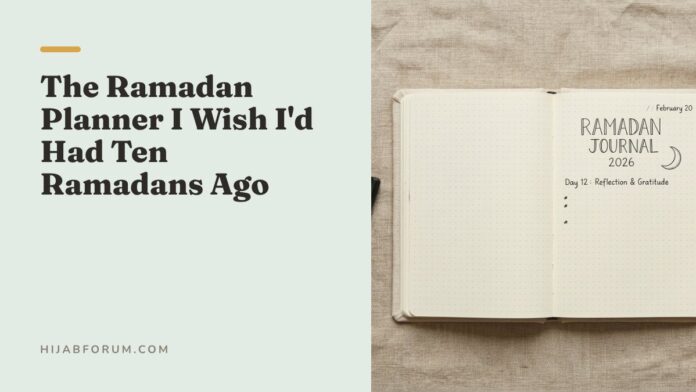
Forty-four pages, letter size, for the thirty days of Ramadan 2027. It is built around five things: salah on time, the Quran read with attention, duas made with specific words, meals that keep you well enough to worship, and one small deed a day.

Print it and bind it at any print shop, or open the PDF in Goodnotes or Notability and write on it directly.

What’s inside

Before Ramadan begins. One page, filled in the night before the first fast. Your intention, the one habit you want to keep after Eid, your Quran goal, the people you will make dua for every night, your sadaqah plan, and what you are cutting back on. This is the page you come back to on day fifteen when you have lost the thread.

Surah checklist. All 114, with a box next to each. Tick them as you go. All 114 ticked is one full khatm.

Dhikr tracker. Twelve daily remembrances across thirty days in one grid: morning and evening adhkar, istighfar, salawat, the tasbih after salah, Ayat al-Kursi, Surah Al-Mulk at night, the dua after the adhan, sadaqah.

30 daily challenges. One small deed a day in any order. Pray Fajr in the masjid. Call a relative you have not spoken to in a while. Teach a child one dua. Spend an hour with no phone after iftar. Pay for the person behind you.

Quran tracker. One juz a day finishes the Quran in thirty days. A box per day, with the odd nights of the last ten shaded.

Four weekly meal plans. Suhoor, iftar, and prep-ahead for every day of the week, with a grocery list, a freezer and batch-cook box, and a spot for iftar guests.

Thirty daily pages. This is the heart of it. One full page per day with salah (fard and sunnah), Quran, three things you are grateful for, the dua you are making today, suhoor and iftar, water, a good deed, mood, and notes. Days 21 to 29 carry a reminder on the odd nights.

The last ten nights. A page for each night with the dua of Laylatul Qadr at the top. Plan each night before Maghrib.

Eid preparation. A checklist that starts on day twenty, an Eid day plan, the Eid menu, and a gift list with budget and done boxes.

Duas for Ramadan. Five to keep close this month, with Arabic, transliteration and meaning: sighting the new moon, breaking the fast, the dua at iftar, Laylatul Qadr, and seeking forgiveness.

How I’d use it

Fill in the first page the night before Ramadan. Then every morning after Fajr, open the daily page and spend two minutes on it: what you are grateful for, the dua you are making, what you are cooking. Tick things as the day goes. At night, before sleep, the mood circles and the notes.

You will miss days. Everybody does. The planner is not a scorecard. It is a place to come back to, and a half-finished planner that gets opened on day twenty-eight is doing its job.

Get the planner

Ramadan Planner 2027, 44-page printable PDF, $9.99

If you have little ones, the 30 Everyday Duas for Kids card set is the children’s version of the same idea: one dua a day, for the whole month.

A printed hardcover edition is coming in November for anyone who would rather have it in their hands than on their printer.

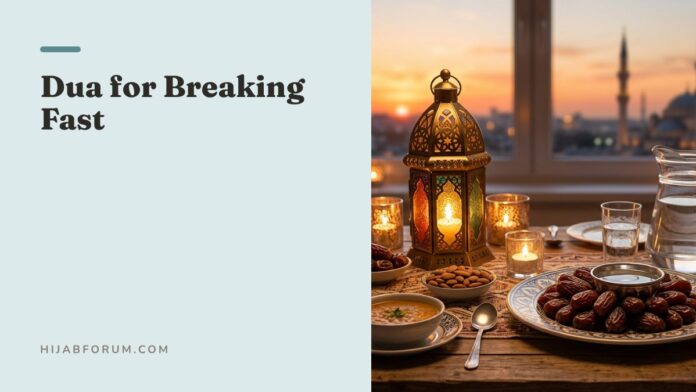
Dua for Breaking Fast: What to Say at Iftar (and the One You’ve Probably Never Heard)

0
dua for breaking fast

The moment before the first date at iftar is one of the most answered moments of the year. The Prophet ๏ทบ said that the fasting person has, at the time of breaking the fast, a supplication that is not rejected. Most of us spend it reaching for the water. Here is what to say instead.

The dua for breaking fast

This is the one narrated from the Prophet ๏ทบ, in Abu Dawud. He said it after he broke his fast.

Arabic

ุฐูŽู‡ูŽุจูŽ ุงู„ุธูŽู‘ู…ูŽุฃู ูˆูŽุงุจู’ุชูŽู„ูŽู‘ุชู ุงู„ู’ุนูุฑููˆู‚ู ูˆูŽุซูŽุจูŽุชูŽ ุงู„ู’ุฃูŽุฌู’ุฑู ุฅูู†ู’ ุดูŽุงุกูŽ ุงู„ู„ูŽู‘ู‡ู

Transliteration

Dhahabaz-zama’u wabtallatil-‘uruqu wa thabatal-ajru in sha Allah.

Meaning

The thirst has gone, the veins are quenched, and the reward is confirmed, if Allah wills.

Say it after the first sip or the first date, since it describes what has just happened. It is short, it is in the Sunnah, and it is the one to teach the children.

The dua of Ibn Umar at iftar

Abdullah ibn Umar, may Allah be pleased with him, was heard saying this when he broke his fast. It is in Ibn Majah.

Arabic

ุงู„ู„ูŽู‘ู‡ูู…ูŽู‘ ุฅูู†ูู‘ูŠ ุฃูŽุณู’ุฃูŽู„ููƒูŽ ุจูุฑูŽุญู’ู…ูŽุชููƒูŽ ุงู„ูŽู‘ุชููŠ ูˆูŽุณูุนูŽุชู’ ูƒูู„ูŽู‘ ุดูŽูŠู’ุกู ุฃูŽู†ู’ ุชูŽุบู’ููุฑูŽ ู„ููŠ

Transliteration

Allahumma inni as’aluka birahmatikal-lati wasi’at kulla shay’in an taghfira li.

Meaning

O Allah, I ask You by Your mercy which envelopes all things, that You forgive me.

This is the one to say in the quiet seconds before the adhan, when the dua is not rejected. It asks for the one thing that matters most, and it asks by the one thing that is biggest.

About “Allahumma laka sumtu”

You have probably seen a third dua, usually printed on iftar timetables: “Allahumma laka sumtu wa bika amantu wa ‘ala rizqika aftartu,” meaning “O Allah, I fasted for You, I believed in You, and with Your provision I break my fast.” Its chain of narration is weak according to the scholars of hadith, which is why it does not appear in Fortress of the Muslim. The meaning is sound and there is nothing wrong with the words. The two above are simply better established, so those are the ones we teach first.

Making the most of the moment

The dua before iftar is a moment many of us waste, because by the time Maghrib comes we are tired, the table needs setting, and the children are circling. A few things that help:

Set the table ten minutes early so the last minutes before the adhan are free. Have the dates and water already out. Sit down. Make your own dua in your own words for the things that matter to you this year, then say the dua for breaking fast after the first date. It takes two minutes, and it is two minutes the Prophet ๏ทบ said would be answered.

With children, keep it to the first dua. “The thirst has gone” is concrete enough for a five-year-old to understand and short enough to say every night for thirty nights. By the end of Ramadan they will say it before you do.

Related

Both of these duas are on the Duas page of the Ramadan Planner 2027, which also has a daily page for every day of the month with a suhoor and iftar section. The first one is card 28 in the 30 Everyday Duas for Kids set.

30 Everyday Duas for Kids (and the Trick That Actually Gets Them to Stick)

0
everyday duas for kids

Most of us learned our duas the same way. Somebody said them near us, over and over, at the same moment every day, until one day we were saying them too. Nobody sat us down with a workbook. The dua for leaving the house was taught at the door, with shoes half on. The dua before eating was taught at the table, with the food already in front of us.

That is still the way it works. Kids learn duas by hearing them where the moment happens, not by memorising a list. So the question is how to make sure the words are there, at the door and the table and the bedside, often enough that they stick.

The trick: put the dua where it happens

Print the dua and tape it to the spot. The bathroom door gets the bathroom dua. The fridge gets the dua before eating. The car gets the travel dua. The bedside gets the sleep dua. Every time your child meets the moment, the words are right in front of them, and in front of you, which matters just as much, because the parent saying it out loud is the whole engine.

After a few weeks the card is doing nothing. The child says the dua before you do. That is when you move the card to the next spot.

The 30 duas, in the order a day happens

Here are the thirty we chose, grouped by when they come up. Every one is short, authentic, and from the Quran or the Sunnah.

Morning and getting ready
1. When I wake up
2. When I get dressed
3. Entering the bathroom
4. Leaving the bathroom
5. After wudu

Food
6. Before I eat
7. If I forget Bismillah
8. After I eat

Out and about
9. Leaving home
10. Coming home
11. Riding in the car
12. Entering the masjid
13. Leaving the masjid

Learning
14. Before I study
15. When something is hard

Everyday moments
16. When I sneeze
17. When someone sneezes
18. When I see something I love
19. When I make a plan
20. When I say thank you
21. When I make a mistake

Big feelings
22. When I feel angry
23. When I feel scared
24. When I get hurt

Caring for others
25. Visiting someone sick
26. When it rains
27. For my parents

Ramadan
28. When I break my fast
29. On Laylatul Qadr

Night
30. Before I sleep

A few of these are tiny, like Bismillah or Alhamdulillah. We kept them in on purpose. A three-year-old who can say Bismillah before every meal has a dua habit, and that habit is the foundation everything else gets built on.

Why each card has three lines

Every card has the Arabic, a simple transliteration, and the English meaning. The Arabic is what we want them to say. The transliteration is for the parent who did not grow up reading Arabic and does not want to guess. The meaning is the part that turns a sound into a dua, because a child who knows they are asking Allah for protection when they feel scared is doing something different from a child repeating syllables.

Each card also has its source, so you know where it comes from. We cross-checked the collection against Fortress of the Muslim.

Thirty cards, thirty days

If Ramadan is coming, this is one dua a day for the whole month. Put the new card up after iftar, say it together, and leave the old ones where they are. By Eid the house is covered and so is the child.

Get the cards

The set is a 7-page printable PDF: a cover, a how-to page, and 30 cards with cut lines, six to a page. Print on cardstock, cut, and tape.

Get the 30 Everyday Duas for Kids card set, $6.99

Pair it with the Ramadan Planner 2027 if you want the grown-up version of the same idea.

Mental Health in Islam: What the Quran, Sunnah, and Islamic Scholars Really Say

0
Muslim woman in hijab sitting peacefully with Quran and prayer beads โ€” mental health in Islam

Mental health in Islam is not a modern conversation. It is one that has been unfolding for over 1,400 years. Yet for many in our Muslim communities, talking openly about mental health struggles still feels taboo, shameful, or even spiritually suspect. If you have ever wondered what Islam truly says about the mind, the heart, and the healing process, this post is for you.

The importance of mental health is woven into the fabric of Islamic teachings. Islam does not treat the soul in isolation from the body and mind, it takes a holistic approach to human well-being, one that honors the full complexity of what it means to be a human being. Understanding this is not just academically interesting. For millions of Muslims navigating mental health challenges today, it can be life-changing.

Islam Has Always Taken Mental Health Seriously

Long before the field of clinical psychology existed in the West, Muslim scholars were writing about the human mind, emotional distress, and mental illnesses with remarkable depth. Scholars of the Islamic Golden Age, including Ibn Sina (Avicenna), whose work formed the foundation of medicine for centuries, described conditions we now recognize as depression, anxiety, and psychosis, and advocated for treatment rather than punishment or isolation.

This tradition of care is not a footnote in Islamic history, it is central to it. The great emphasis Islam places on the well-being of the whole person, body and soul, reflects a deep understanding of human nature. The Prophet Muhammad ๏ดฟ๏ดพ himself was deeply attuned to the emotional and mental states of those around him. He comforted, listened, and responded to the mental health needs of his companions with extraordinary compassion.

The Islamic perspective has never been that emotional pain is weakness, or that mental health issues are shameful. Quite the opposite โ€” the Quran and Sunnah are full of acknowledgment of human suffering and guidance for moving through it.

The Prophet Muhammad (๏ทบ) and the Year of Sorrow

One of the most profound examples of mental health in Islamic tradition is the story of the Year of Sorrow โ€” ‘Am al-Huzn. In one single year, the Prophet (๏ทบ) lost his beloved wife Khadijah (may Allah be pleased with her), the person who was his closest companion and greatest support, and his uncle Abu Talib, who had protected him throughout the years of persecution in Makkah. The grief was so overwhelming that this period is recorded in Islamic history specifically by its emotional weight.

Allah’s Messenger (๏ทบ) did not hide his grief. He wept. He mourned. And in response to his emotional struggles, Allah revealed Surah Ad-Duha, a surah of divine reassurance, comfort, and good tidings. ‘Your Lord has not abandoned you, nor is He displeased with you.’ These words were revealed to address the Prophet’s mental state directly. This is not a small thing. This tells us that in the Islamic tradition, feelings of sadness, grief, and heaviness are real, are acknowledged, and are met with divine care.

This is the example of the best of human beings, a man who grieved openly, who was comforted by his Lord, and who continued to serve with strength. The Prophet (๏ทบ) is our model not just in worship, but in emotional wellness.

Mental Illness Is Not a Sign of Weak Faith

Perhaps no myth causes more harm in Muslim communities than this one: that mental health difficulties are a sign of weak faith. This idea has no basis in the Quran or the Sunnah, and it has driven countless Muslims away from the professional help they desperately need.

Consider the stories of the prophets. Nabi Yaqub (AS) wept so intensely for his son Yusuf that he lost his sight from grief, and he was a prophet of Allah. Nabi Ayyub (AS) endured years of physical and emotional suffering and is praised in the Quran for his patience. Nabi Yunus (AS) found himself in a place of profound darkness, crying out, ‘There is no god but You, glory be to You, indeed I have been among the wrongdoers.’ These were not people of weak faith, they were among the greatest human beings to have walked this earth.

Mental health struggles โ€” including depression, anxiety, trauma, and mental illnesses โ€” are part of the human experience. They are not punishments. They are not evidence that a person is far from Allah. In fact, for many Muslims, mental health challenges become the very catalyst that deepens their connection to Allah, their daily prayers, and their spiritual practices.

Dr. Rania Awaad, a Muslim psychiatrist and Islamic scholar at Stanford University who specializes in Muslim mental health, has spoken extensively about dismantling this stigma. Her work, along with that of the Yaqeen Institute and other scholars, is helping to reshape how Muslim communities understand mental well-being. As she has noted, seeking treatment for mental health is as valid and necessary as seeking treatment for any physical illness.

What the Quran and Sunnah Say About Emotional Well-Being

The Quran is filled with acknowledgment of human emotional life. It speaks to fear, grief, loneliness, anger, love, hope, and despair, not to dismiss these feelings, but to address them. ‘Verily, in the remembrance of Allah do hearts find rest.’ (Surah Ar-Ra’d, 13:28), this is perhaps one of the most widely quoted ayaat on mental well-being, and for good reason. Regular dhikr (the remembrance of Allah) is described here not just as a spiritual practice but as a source of genuine inner peace.

Surah Al-Baqarah contains some of the most powerful reassurances for those going through difficult times: ‘Allah does not burden a soul beyond that it can bear.’ (2:286). This ayah is not a dismissal of pain. It is a declaration of divine knowledge about each individual’s capacity. For Muslims navigating emotional distress, this is an anchor.

The Sunnah reinforces the validity of negative emotions and the importance of expressing them in healthy ways. The Prophet ๏ดฟ๏ดพ said, recorded in Sahih Bukhari: ‘The eyes shed tears, and the heart grieves, and we will not say except what pleases our Lord.’ He also said in Sahih al-Bukhari that the believer who mixes with people and endures their harm with patience is better than one who does not mix with them, a recognition that human connection and community support are essential, and that engagement with life’s difficulties is a form of strength, not weakness.

Islamic teachings also introduce the concept of husn al-dhann, having a good opinion of others and of Allah. Modern cognitive therapy has echoed this insight: the way we interpret situations and people, and whether we default to charitable or suspicious assumptions, has a measurable impact on our mental state. The sunnah of husn al-dhann is, in many ways, an Islamic framework for cognitive wellness.

Islamic Practices as Powerful Tools for Mental Well-Being

Islam provides a rich collection of spiritual practices that support mental well-being, not as replacements for professional care, but as powerful tools that work alongside it. Research in clinical psychology has increasingly validated what Islamic tradition has taught for centuries.

Daily prayers, the five daily salah, structure the day in a way that provides rhythm, grounding, and consistent moments of connection with Allah. The act of physically bowing and prostrating has been shown to have calming effects on the nervous system. Each salah is a pause in the noise of daily lives, a return to what matters most.

Regular dhikr, whether that is Subhanallah, Alhamdulillah, Allahu Akbar, or the powerful dua ‘O Allah, I seek refuge in You from anxiety and sorrow’ (Allahumma inni a’udhu bika min al-hamm wal-hazan), is a form of spiritual grounding that directly addresses the mental state. The Prophet(๏ทบ) taught us specific duas for states of anxiety and grief because he understood that human beings need words to meet their pain.

Acts of worship more broadly, reading Quran, fasting, giving charity, performing acts of kindness, all contribute to a sense of purpose, connection, and meaning. A strong sense of purpose is one of the most consistent protective factors in mental health research. Islam builds this into the architecture of daily life.

Good deeds and acts of kindness are also deeply connected to mental well-being. The Prophet ๏ดฟ๏ดพ said that every act of charity is sadaqah, even a smile, and the research on pro-social behavior and mood is clear: giving consistently improves emotional well-being. This is not coincidence. It is design.

Seeking Professional Help: What Islam Says

One of the most necessary steps any Muslim struggling with mental health challenges can take is to seek professional help, and this is entirely consistent with Islamic values. In fact, it is encouraged.

The Prophet Muhammad (๏ทบ) said: ‘Make use of medical treatment, for Allah has not made a disease without appointing a remedy for it, except one disease โ€” old age.’ (Abu Dawud). Muslim scholars have long held that seeking all forms of treatment for illness, including mental illness, is not only permissible but recommended. The use of medical treatment for mental health conditions is not a rejection of tawakkul (reliance on Allah); it is an act of taking the means that Allah has provided.

Today, the field of Islamic psychology is growing rapidly, with Muslim therapists and clinicians trained in both clinical psychology and Islamic theology. Finding a Muslim therapistโ€”one who understands your religious beliefs, your cultural context, and can integrate faith into the healing processโ€”can be enormously beneficial. Organizations like the Institute for Muslim Mental Health and resources from the Yaqeen Institute can help connect muslim patients with culturally competent mental health services.

Clinical treatments, including cognitive therapy, medication where needed, and other evidence-based approaches, are tools, not failures of faith. They are forms of treatment that Allah has made available to us, and using them is an expression of care of our bodies and minds, which are amanah (trusts) given to us by Allah.

If you are a family member supporting someone through mental health difficulties, know that encouraging professional help is one of the most loving things you can do. Removing stigma within your own home is a form of community support that ripples outward.

The Role of Muslim Communities in Mental Health

Muslim communities carry enormous potential to either compound or alleviate mental health struggles for their members. In many Muslim societies, the stigma around mental illnesses remains significant, and this has real consequences. People suffer in silence. They avoid treatment. They carry shame that has no basis in Islamic tradition.

The Prophet (๏ทบ) described the believers as being like one body: ‘When one part of the body suffers, the whole body responds with sleeplessness and fever.’ (Sahih al-Bukhari). This is a vision of community support that is active, not passive. It means noticing when a family member or neighbor is struggling. It means creating spaces, support groups, mosque programs, online communities, where mental health struggles can be named without shame.

Religious leaders in the Muslim community have a particularly important role to play. When imams and scholars speak openly about mental health from the minbar, when they affirm that emotional struggles do not make you less of a Muslim, and when they point people toward professional help alongside spiritual guidance, lives are saved. This is dawah in the deepest sense โ€” a demonstration that Islam embraces the full reality of being human.

Muslim communities are also uniquely positioned to hold space for grief, loss of wealth, relationship difficulties, and the ordinary hard moments of human life in ways that Western psychology cannot always offer. The concept of being held by the ummah, by a believing community, is itself a form of support system that has been shown to positively affect mental well-being.

Practical Steps for Better Mental Health as a Muslim

Here are practical steps rooted in both Islamic tradition and current understanding of mental well-being that you can take in your daily life:

  • Protect your salah. Daily prayers are not just obligations โ€” they are anchors. Even in your hardest seasons, hold on to them.
  • Build a regular dhikr practice. Start small โ€” even ten minutes of remembrance of Allah after Fajr can shift your mental state over time.
  • Recite Surah Al-Baqarah regularly. The Prophet (๏ทบ) said it drives away Shaytan, and its verses address the full spectrum of human emotional struggle.
  • Learn the duas for anxiety and distress. The Prophet (๏ทบ) gave us specific supplications for mental struggles, learn them and keep them close.
  • Seek professional help without shame. Contact a Muslim therapist or a mental health professional who understands your Islamic context. This is a necessary step, not a last resort.
  • Connect with your community. Isolation worsens mental health challenges. Find a support group, attend your masjid, and reach out to a trusted friend or religious leader.
  • Practice husn al-dhann โ€” good opinion of Allah. When life feels heavy, actively choose to believe that Allah knows your pain, sees your effort, and has good planned for you.
  • Tend to your physical health. Sleep, movement, nutrition, and time in nature all directly affect mental well-being. Caring for your body is caring for your amanah.

You Are Not Alone โ€” And Islam Has Always Known That

If you are navigating mental health challenges right now, know this: Islam has always seen you. Every prophet who grieved, every companion who struggled, every scholar who wrote about the depths of emotional pain โ€” they are all part of a tradition that says your inner life matters.

The ultimate happiness Islam points us toward โ€” falah, the deep flourishing of the soul โ€” is not the absence of struggle. It is the presence of Allah in the midst of it. It is the sense of purpose that comes from knowing why you are here. It is the healing process, however long it takes, walked with faith, community, and the best professional help available to you.

Mental health in Islam is not a contradiction in terms. It is a conversation our tradition has been having since the beginning. It is time for our communities to have it openly, with compassion, without shame, and with the full understanding that seeking mental health support is one of the most courageous and Islamic things a person can do.

May Allah grant us all mental well-being, ease our emotional struggles, surround us with community support, and guide us to the practical solutions and professional help that our mental health needs. Ameen.

Resources

If you are looking for more on Muslim mental health from an Islamic perspective, the Yaqeen Institute has an excellent collection of research and articles. Dr. Rania Awaad’s work at Stanford on Islamic psychology and clinical psychology integration is also highly recommended. For mental health services, look for therapists trained in both Western psychology and the Islamic context, or reach out to Muslim mental health organizations in your area.

Setting Boundaries with Adult Children: A Practical Guide for Parents

0

Setting boundaries with adult children is one of the most emotionally complex things a parent can face. You love them. You have spent years putting their needs first. And now you are trying to figure out how to hold a line, protect your peace, and still maintain a healthy relationship with the adult kids you raised.

It is hard. And it is necessary.

This guide is for parents who want to set clear boundaries with their adult children in a way that is loving, firm, and sustainable. Whether the challenge is financial support, living arrangements, disrespectful behavior, or navigating new dynamics in the parent-child relationship, this practical guide walks you through it step by step.


Why Setting Boundaries with Adult Children Feels So Hard

Many parents struggle with this because the shift from parenting young children to relating to young adults requires a complete rewiring of the relationship. What worked before no longer applies, and many parents find themselves in a hard time trying to figure out how to relate to their adult kids without either over-controlling or being completely walked over.

There is also the guilt. The fear that setting any limit means you are a bad parent, that you are breaking family relationships, or that your adult child will pull away entirely. These fears are understandable, but they often lead parents to stay silent far too long, and that silence builds resentment on both sides.

The parent-child relationship does not end when a child turns 18. But it does need to change. And that change requires both parties to develop a new kind of mutual respect.


What Boundaries Actually Are (and What They Are Not)

A boundary is not a punishment. It is not a way to control your adult child’s own decisions or their own choices about how they live their life.

A boundary is a clear statement about what you will and will not accept in your own home, your own life, and your own relationships. It is about protecting your emotional support, your financial stability, and your mental health, not about managing theirs.

When parents confuse the two, they try to set “boundaries” that are really attempts to control their adult child’s behavior, and those almost always backfire. True boundaries are about you. They define what you will do, not what your adult kids must do.

This distinction is essential. It is also what makes examples of healthy boundaries so much more effective than rules, ultimatums, or ongoing conflict.


Common Situations That Call for Clear Boundaries

Financial Support

One of the most common pressure points in families is money. Adult children who repeatedly ask for much money without a plan for repayment, who expect ongoing financial support past a reasonable transition period, or who make financial decisions that affect household expenses without consultation are all situations where clear boundaries are essential.

You are not required to continue providing financial support indefinitely. You can love your child deeply and still say: this is what I am able to offer, and this is where it ends.

Living at Home as an Adult

When adult kids live in the family home, establishing house rules and clear expectations early is far easier than addressing problems after the fact. Questions around household expenses, chores, schedules, guests, and a timeline for independence are all worth discussing openly.

The goal is not to make your adult child feel unwelcome. It is to create a living situation with mutual respect that works for everyone under the roof.

Disrespectful Behavior

You have every right to expect to be spoken to with respect in your own home and in your family relationships. If your adult child speaks to you in a way that is hurtful, dismissive, or abusive, that is a situation that calls for clear boundaries immediately.

This includes guilt trips, ongoing unsolicited advice directed at you, elder abuse in any form, and patterns of communication that leave you feeling drained, dismissed, or afraid.

Emotional Over-Dependence

Some adult children lean on their parents for emotional support in a way that becomes exhausting and unhealthy for the parent. There is a difference between being a good friend to your adult child and being their only source of support. If you are fielding daily phone calls, managing their mental health crises, and carrying the weight of their emotional life on top of your own, that is a dynamic that needs to change.


How to Set Boundaries with Adult Children: Step by Step

Step 1: Get Clear on What You Need

Before you can communicate a boundary, you need to know what you actually need. This requires honest reflection.

Ask yourself: what behavior is affecting my wellbeing right now? What would a healthy relationship with my adult child look like? What am I willing to offer, and what am I not?

Write your answers down. The goal is to move from a vague feeling of resentment or overwhelm into a specific, clear understanding of what needs to change in the long run.

Step 2: Separate the Behavior from the Person

You can love your adult child and still not accept certain behavior. These two things are not in conflict.

When you are clear on this, it changes how you communicate. Instead of “you are taking advantage of me,” you say “I am not able to continue lending money without a repayment plan.” One attacks the person. The other names the specific situation and your specific response. This shift makes it a much better relationship conversation and a much easier one for your adult child to actually hear.

Step 3: Choose the Right Moment for Difficult Conversations

Do not try to set a serious boundary in the middle of a conflict. Emotions are too high and neither person is really listening. Choose a calm moment for these difficult conversations when both of you are relaxed and not already defensive.

In person is almost always better than a phone call or a text message. The tone of your voice and your body language matter a great deal, especially in emotionally charged family members conversations.

Step 4: Say It Clearly and Simply

When you speak, be direct. Avoid long speeches and endless justifications. The more you over-explain, the more it sounds like you are asking for permission.

A simple, clear statement is more powerful:

“I love you and I want to support you. But I am not in a position to keep providing financial support past the end of this year.”

“Living together is only going to work if we agree on some basic household rules around expenses and shared responsibilities.”

“When you speak to me that way, I am going to end the conversation. We can try again when things are calmer.”

Say it once, clearly. You do not need to convince them the boundary is fair. You just need to state it.

Step 5: Follow Through Consistently

This is where most parents of adult children struggle. Setting a limit and then abandoning it the moment your adult child pushes back teaches them that the limit was not real.

Consistency is what makes clear boundaries effective in the long run. If you say you will not lend money and then lend money two weeks later, you have not set a boundary. You have started a negotiation. You can be warm, loving, and compassionate and still hold firm: “I understand you are frustrated. My answer is still no.”


What to Do When They Push Back

Adult kids often push back when parents begin to set limits, especially after years of a different dynamic. You may face guilt trips, minimizing, anger, or repeated asking. None of these responses mean your boundary is wrong.

Stay calm. Hold your position. Repeat it briefly if needed. You do not owe them a debate.

If your adult child threatens to cut contact or says hurtful things in response, that is important information about the relationship. It does not mean you were wrong to speak up. It means the work of building a better relationship may need to include therapy sessions, either individually or together.


Boundaries for Specific Situations

Adult Kids Living at Home

Establish clear house rules early. These might include contributions to household expenses, shared chores, guest policies, and a realistic timeline toward independence. A simple, honest agreement reached in an open communication conversation is far better than repeated arguments about the same issues.

Financial Boundaries

Be honest about your own limits. You are not required to provide financial support at the expense of your own stability or retirement. If you choose to help, make the terms clear upfront. Is it a loan or a gift? What are the expectations? Clarity prevents resentment.

Communication Boundaries

Name the specific behavior and what will happen if it continues: “When you raise your voice at me, I will leave the room. We can talk again when things are calmer.” Then follow through, every time.


Taking Care of Yourself Through This Process

Setting limits with a child you love is emotionally exhausting. You may feel guilty, sad, or deeply conflicted. That is normal. A few things that help:

Talk to someone you trust. A good friend, a therapist, or a counselor can help you process what you are going through and stay grounded.

Give yourself permission to need things too. You are a human being with your own mental health, your own needs, and your own emotional wellbeing. Protecting those things is not selfish. It is necessary.

Be patient with the process. Change in family relationships rarely happens overnight. New dynamics take time to establish. Stay consistent and trust the ongoing process.

Remember that healthy relationships require mutual respect. A respectful relationship is one where both people feel safe, heard, and valued. That applies to the parent-child relationship too, regardless of age.


Final Thoughts

Setting boundaries with adult children is one of the hardest things a parent can do, because you are doing it while loving them, worrying about them, and wanting the best for them all at once.

But love without limits is not healthy love. And protecting your own life, your peace, and your wellbeing is one of the most honest things you can do for yourself and for the long-term health of your family relationships.

You can do this with love. You can hold firm with compassion. And in the long run, clear boundaries often bring families closer together, not further apart.